Are you paying enough? How a competitive salary helps you retain your best employee

Employee retention starts with one critical question: are your salaries competitive enough to keep your best people? In this article, we explore why pay matters, how dissatisfaction drives employee turnover, and what employers can do to stay ahead. You’ll also learn why salary guides are essential for building a strong employee retention strategy across APAC.
Across the region, talent retention is one of the most pressing challenges for employers. Our 2025 Talent Trends research shows that 48% of professionals are actively looking for a new job, and salary dissatisfaction is a major driver. In fact, 46% feel unsure or believe they are not paid fairly for the work they do. These figures highlight a growing disconnect between employer pay strategies and employee expectations.
When top performers leave, the cost is more than financial. Productivity drops, team morale suffers, and recruitment expenses rise. In competitive markets, losing key talent can significantly set back business growth. The question is not whether you can afford to offer a competitive compensation package – it’s whether you can afford not to.
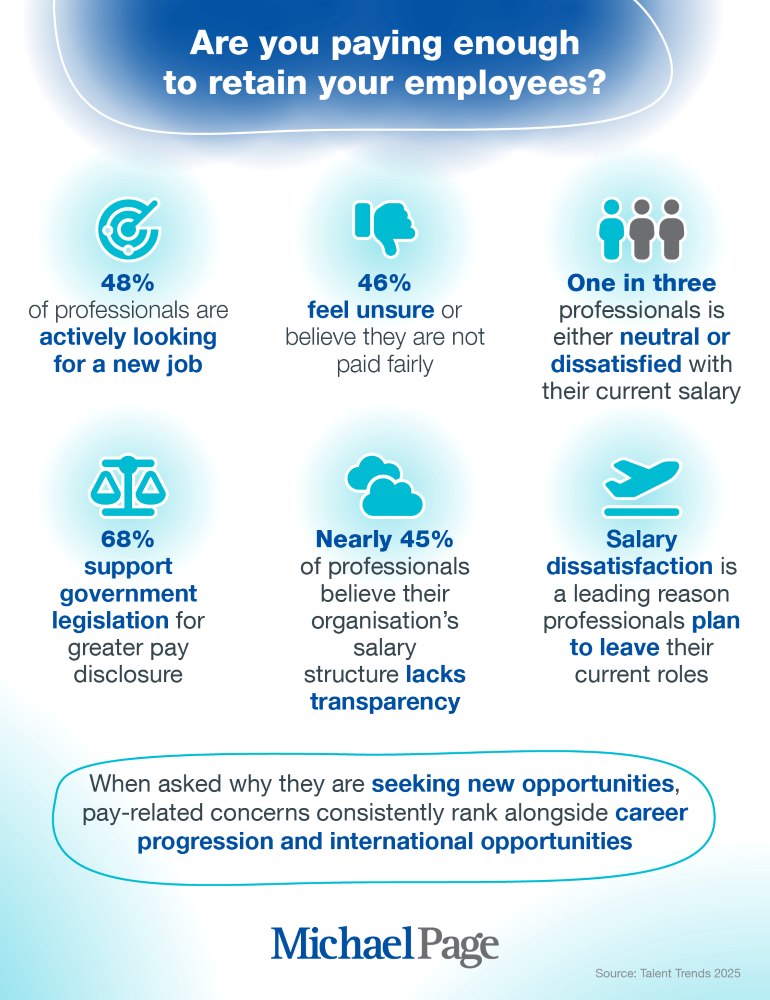
Salary remains a cornerstone of employee engagement. Yet, our data shows that satisfaction levels are far from ideal. One in three professionals is either neutral or dissatisfied with their current salary. This matters because pay perception influences loyalty. When employees believe they are underpaid, they are more likely to explore external opportunities.
The challenge for employers is compounded by inflation and rising living costs. Professionals are increasingly benchmarking their pay against peers and industry standards. If your salary structure hasn’t been reviewed recently, you may already be behind.
Pay transparency is becoming a critical expectation. Nearly 45% of professionals believe their organisation’s salary structure lacks transparency, and 68% support government legislation for greater pay disclosure. Lack of clarity erodes trust and can push employees to seek opportunities elsewhere.
Transparent pay practices build confidence and loyalty – not just compliance. When employees understand how their salary is determined, they are more likely to stay engaged and committed. Employers should consider publishing pay bands internally and explaining how progression works. This simple step can reduce uncertainty and improve retention.
Replacing an existing employee is expensive. The Society for Human Resource Management (SHRM) estimates the average cost-per-hire to be nearly US$4,700. Compare this with a pay adjustment of 10% to 15%, which is often enough to bring salaries in line with market expectations. The financial case for proactive salary reviews is clear – paying competitively costs far less than losing and replacing top talent through a lengthy and costly hiring process.
Our Talent Trends data reinforces this point. Salary dissatisfaction is a leading reason professionals plan to leave their current roles. When asked why they are seeking new opportunities, pay-related concerns consistently rank alongside career progression and international opportunities. Employers who ignore this risk higher turnover rates, increased attrition, and the associated costs.
In a market that changes fast, relying on outdated benchmarks can be costly. Salary guides provide employers with accurate, market-specific data to make informed decisions. They help you:
Our salary guide is designed to give you a competitive edge. It covers salary ranges across functions and industries, helping you stay ahead in attracting and retaining talent. Using this resource allows you to develop a competitive salary strategy based on real market data – not guesswork.

Here are some action points for employers and hiring managers to consider:
Salary expectations shift quickly in APAC markets. Use up-to-date salary guides to benchmark your ranges against industry standards. This helps you identify gaps before they become retention risks and supports lower turnover across teams.
Transparency matters. Employees want to understand how their salary is set and how progression works. Publish internal pay bands and the criteria for moving between them. Make the link to performance explicit and be clear about how you reward skills growth and impact. This approach reduces uncertainty and boosts engagement.
Salary guides are not just for recruitment; they are a strategic tool for retention. They provide insights into emerging roles, salary trends, and skills in demand. By reviewing these guides regularly, you can adjust pay structures before competitors lure your talent away – minimising turnover costs and sustaining retention over time.
Retention is not just about paying more – it is about paying fairly and offering a holistic value proposition. Companies that combine transparent compensation with career growth opportunities achieve lower turnover while setting new employees up for success.
Want to know if your salaries are competitive? Download our 2026 Salary Guide or speak to our recruitment experts today.